
A buyer says, "We already have a solution," and you feel the pull to answer immediately. You list what makes your product better. You reach for the rebuttal you rehearsed. The buyer hears a pitch aimed at a sentence, not at them.
Objections are rarely the final word. They are the buyer's first, compressed way of saying something that matters to them: a risk, a priority, a past experience, or a polite exit. Reps who handle objections well do not have better comebacks. They find out what the buyer means before they respond.
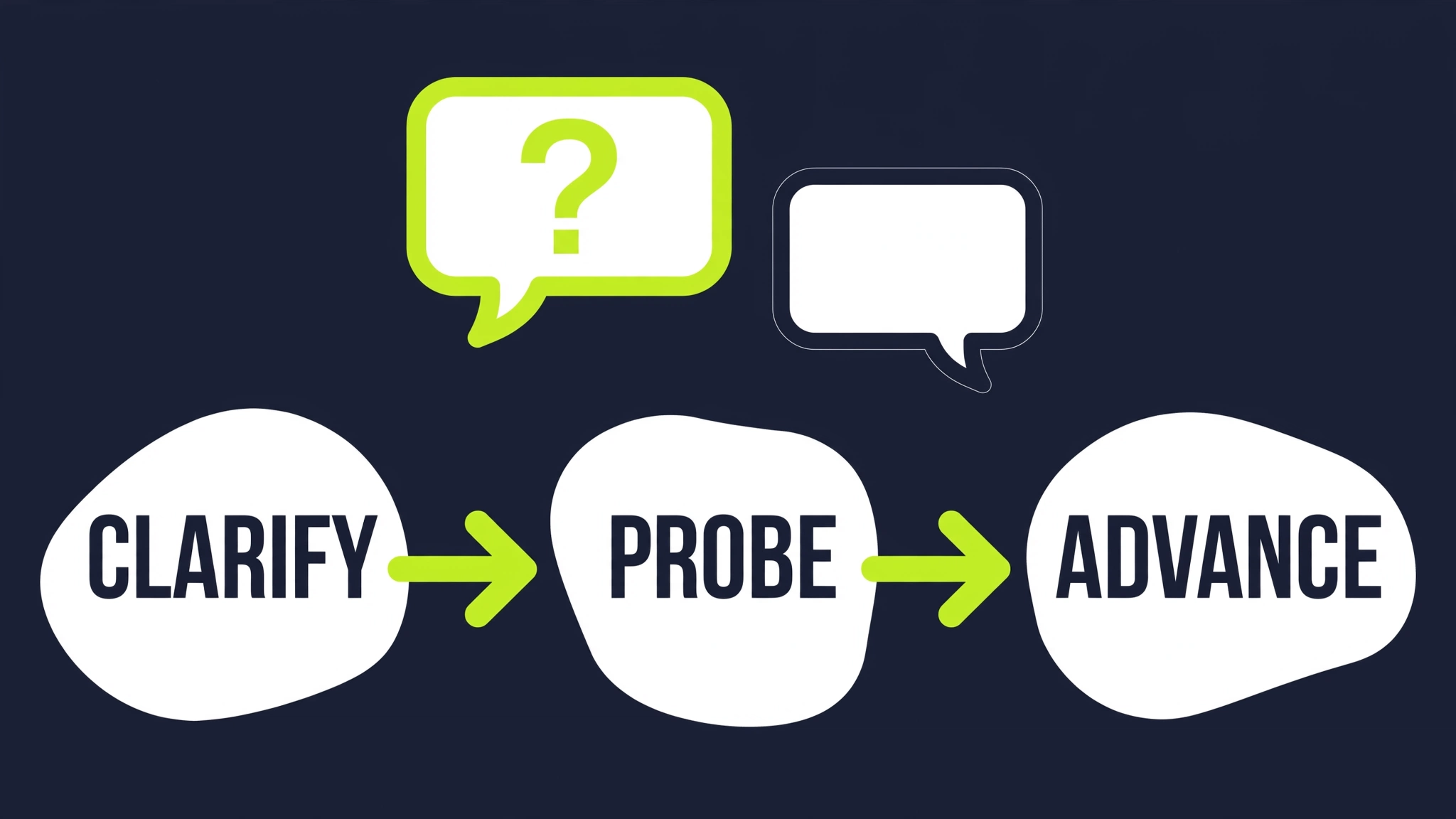
This guide gives individual sales reps a simple three-step approach, Clarify, Probe, Advance, with examples for the objections you hear most. It also shows where live text guidance can help you stay on track during the call.
Why canned rebuttals miss what the buyer means
A rebuttal answers the words. A good response answers the concern behind the words. Those are often different things.
Take "It costs too much." That sentence can mean at least four different things:
- The price is above the budget the buyer was given.
- The buyer cannot yet see what they would get for the money.
- They are comparing you with a cheaper option that looks similar.
- They do not feel enough urgency to spend anything at all.
A scripted line about "value" fits only one of those, and you do not know which one you are facing. Defending the product too early creates a second problem: the buyer stops explaining. The moment you argue, they learn that sharing a concern gets them a counterargument, so they share less.
The fix is not a better script. It is a short sequence that keeps the buyer talking until you know what the objection is really about.
The Clarify, Probe, Advance method
Each step has one job. You can move through all three in under a minute.
Step 1: Clarify the concern
Start by making sure you heard the objection correctly. Acknowledge it in plain words, then ask the buyer to narrow it down. Do not agree with the objection and do not argue with it.
Good clarifying questions are short and neutral:
- "Help me understand, when you say it costs too much, is that compared to a budget, or to something else?"
- "What does the current setup do well for you?"
- "What would you want to see in the information, so I send the right thing?"
Clarifying also slows the moment down. A buyer who answers a question is no longer rejecting you. They are working with you.
Step 2: Probe the underlying priority
Once the concern is specific, ask what sits behind it. This is where you learn what the buyer is trying to protect or achieve: a deadline, a past rollout that went badly, a number someone above them will check.
Useful probing questions follow the buyer's own words:
- "You said follow-up goes quiet after the first check-in. What happens when that thread dies?"
- "If budget were not the issue, what would you need to be true to move ahead?"
- "Who else would look at this, and what will they care about?"
Probe one level at a time. Two or three questions in a row feels like a conversation. Seven feels like an interrogation. Stop when you can state the buyer's priority in one sentence and they would agree with it.
Step 3: Advance with a relevant question or next step
Only now do you bring in your product, proof, or proposal, and you tie it to the priority the buyer just described. Advancing does not have to mean closing. It means moving the conversation to the next useful point.
An advance can be a question ("Would it help to map that handoff together?"), a small commitment ("Can I send a one-page comparison of those two workflows by tomorrow?"), or an introduction to the right person. What matters is that it connects to something the buyer said, not to something you wanted to say.
A hypothetical example: "We already have a solution"
The dialogue below is invented to show the method. It is not a real customer conversation.
Buyer: "We already have a process for following up with leads."
Rep (Clarify): "That makes sense. Which part of that process works well for you today?"
Buyer: "The first email goes out fast. After that it depends on the rep."
Rep (Probe): "When it depends on the rep, what tends to happen to the leads that need a second touch?"
Buyer: "Honestly, a lot of them go quiet. We usually do not notice until the quarter review."
Rep (Advance): "So the first step is solid and the gap is what comes after. Would it help if I walked through how other teams structure that second and third touch, and you tell me whether it fits?"
Notice what the rep did not do. They never claimed the buyer's process was weak. The buyer named the gap, and the next step answers it. That is the difference between a rebuttal and a conversation.
How the method adapts to common objections
No single response works every time. Use these as starting points and let the buyer's actual words change them.
"It costs too much"
Clarify: "When you say too much, is that against a budget you already have, or against what you expected to see?"
Probe: "Which part of the investment needs the most context before you can judge it fairly?"
Advance: Depending on the answer, offer a breakdown of what is included, a smaller starting scope, or a conversation with whoever owns the budget. For more on this objection, see our guide to pricing objection handling in discovery calls.
"Send me information"
This one can be a genuine request or a polite way to end the call. Find out which.
Clarify: "Happy to. What would be most useful for you to see?"
Probe: "Who else will read it, and what will they be looking for?"
Advance: Send something short that answers exactly what they named, and propose a specific time to review it together: "I'll send that today. Can we take ten minutes Thursday to go over your questions?"
"We already have a solution"
Clarify: "What does the current solution handle well?"
Probe: "Where does it fall short of what you would like it to do?"
Advance: If a gap exists, ask whether it is worth exploring. If none does, thank them, ask when they review the setup, and leave the door open. A clean exit protects the next conversation.
Common mistakes to avoid
- Answering before the buyer finishes. Let them complete the sentence, then pause for a beat. The second half of an objection is often the useful part.
- Repeating the same question in new words. If a clarifying question did not work, change the angle or move on.
- Stacking features onto a feelings problem. If the buyer is worried about risk, a longer feature list adds noise.
- Treating every objection as resistance. Some are real requests for information. Some are signs of interest. Ask before you assume.
- Memorizing lines instead of questions. Memorize your three or four best questions and a few proof points. Write the sentences live, from what you hear.
Where live text guidance can help
The method is simple. Using it while a buyer is talking, your notes are across the screen, and you are thinking about the next five minutes is harder. This is where a live aid can take some load off.
ExecPitch listens through the microphone you select, transcribes the conversation, and shows concise text response ideas and a next-best question. It does not speak on the call. You read the suggestion, decide whether it fits what the buyer actually said, and put it in your own words.
A few practical points for using any live guidance well:
- Set your brief first. Before a call, write down the buyer, your goal, and the proof points you may need. ExecPitch lets you set a one-off brief, or reuse a private campaign and approved company knowledge across calls.
- Treat suggestions as prompts. A suggested question is a starting point. Change it to match the buyer's vocabulary.
- Know what the microphone hears. ExecPitch uses only the selected microphone. For remote calls, a speakerphone or a room microphone that picks up both sides works best. It does not capture Zoom, dialer, or headset audio.
- Practice before it matters. Run through the objections you dread most so the three steps feel natural when a real buyer raises them.
You can see how this looks in practice in the interactive demo, which uses illustrative examples rather than customer results.
A short checklist for your next call
- Write down the three objections you hear most often.
- For each one, draft a clarifying question and a probing question in your own voice.
- Decide what a useful next step looks like for each concern.
- On the call, listen to the full sentence, then clarify before you respond.
- After the call, note which question opened the buyer up and reuse it.
Handling objections well comes down to curiosity delivered with confidence. When you know what the buyer means, the right thing to say next gets much easier to find.
Try it on your next call
ExecPitch is built for individual sales reps. You can start a 7-day trial; a card is required at checkout, and unless you cancel before day 8, billing begins at $29.99 USD per month for one representative. See plan details or watch the demo first.